
How to Search Georgia Court Records
Georgia Courts publishes an official E-Access court list that routes users to providers for participating Superior and State Courts. It is a directory, not a single government database of every Georgia court record. The official page warns that an account is required. Coverage depends on the court, provider, and historical period. Magistrate, Probate, Juvenile, and Municipal Court records may use separate local systems or clerk-only access, so an empty provider result never proves that no case exists.
Start with the Georgia event or filing county, not merely a person's current home. Identify the Georgia court from the case type: Georgia felonies and divorces belong in Superior Court; many Georgia misdemeanors and traffic matters go to State Court where one exists; Georgia small claims and evictions begin in Magistrate Court; Georgia estates and marriage licenses belong in Probate Court; and city citations go to Municipal Court. A Georgia case number is the strongest search key. When it is unavailable, use the full party name, name variants, and a narrow date range.
- Determine the Georgia filing county and court class from the citation, arresting agency, case notice, or type of dispute.
- Check Georgia Courts E-Access and choose the exact listed Georgia Superior or State Court. Register with its provider when appropriate.
- Search the native Georgia case number first. Then try full and partial names, alternate spellings, and a filing-date range.
- If the Georgia court is absent or the record is old, use the county directory and contact the correct local clerk for an index or archive search.
- Order a certified Georgia copy from the custodian when the record will be used for a formal purpose. A portal image is not clerk certification.
The Judicial Council and Administrative Office of the Courts maintains the statewide gateway shown below. It links court classes, directories, services, rules, and current notices rather than replacing county clerks.
Use that Georgia gateway to confirm the court and official access route before paying a private provider or assuming that one search covers Georgia.
Georgia Court Records by Level
The Georgia court system has two appellate courts and several trial-level classes. The Supreme Court of Georgia is the final state tribunal and directly reviews assigned subjects such as constitutional questions, election contests, death-penalty cases, and habeas matters. The Court of Appeals of Georgia handles most other appeals. Its 15 judges work in five three-judge divisions. Those divisions are decisional panels, not geographic districts.
Superior Court is Georgia's general-jurisdiction trial court. It operates in every county through 49 judicial circuits and has exclusive authority over felonies, divorces, equity, and title-to-land disputes. State Courts in 71 counties handle misdemeanors, traffic matters, and broad civil work. Probate and Magistrate Courts exist in every county, while cities operate Municipal Courts. The State-wide Business Court hears qualifying complex commercial disputes. Records remain with the court that created them even when judges serve a multi-county circuit.
Typical Georgia appeal path: Magistrate, Probate, Municipal, or State Court › Superior Court where Georgia review is assigned › Court of Appeals or Supreme Court by subject › Supreme Court discretionary review where allowed.
| Court | Jurisdiction | Case Types |
|---|---|---|
| Supreme Court of Georgia | Highest Georgia appellate court | Assigned Georgia direct appeals, certiorari, certified questions |
| Court of Appeals of Georgia | Intermediate Georgia appellate review | Most Georgia civil and criminal appeals not reserved to the Supreme Court |
| Georgia Superior Court | General Georgia trial jurisdiction in all counties | Georgia felonies, divorce, equity, land title, broad civil cases |
| Georgia state and local courts | Limited Georgia trial jurisdiction | Georgia misdemeanors, traffic, probate, small claims, juvenile, city ordinances |
The official classes-of-court gateway provides the state hierarchy and court links in a single view.
The official Georgia structure is the safest way to identify which Georgia clerk holds a particular Georgia record.
Types of Georgia Court Records
Georgia court files reflect both case type and court authority. A civil Superior Court file can contain a complaint, service returns, answers, motions, orders, judgment, and appeal papers. Magistrate civil files are often shorter and cover claims up to $15,000, dispossessory cases, and garnishments. Discovery exchanged by the parties is not a public court record unless it is filed. Domestic cases may include a divorce complaint, financial affidavit, parenting plan, settlement, temporary orders, and final decree, with sensitive family material redacted or sealed.
- Georgia criminal records: indictment or accusation, arraignment, motions, plea or verdict, sentence, and later review.
- Georgia civil records: claims, defenses, service, hearings, orders, judgments, liens, collection, and appeals.
- Georgia domestic records: divorce, custody, support, alimony, property division, modification, and contempt filings.
- Georgia probate records: wills, petitions, heirs, letters, inventories, claims, distributions, guardianships, and discharge.
- Georgia traffic records: citations, plea, court dates, amended charges, disposition, fines, warrants, and closure.
- Georgia juvenile records: delinquency and child-welfare proceedings subject to strict role-based access limits.
Georgia Courts offers a plain-language court navigation resource for matching disputes to a court class.
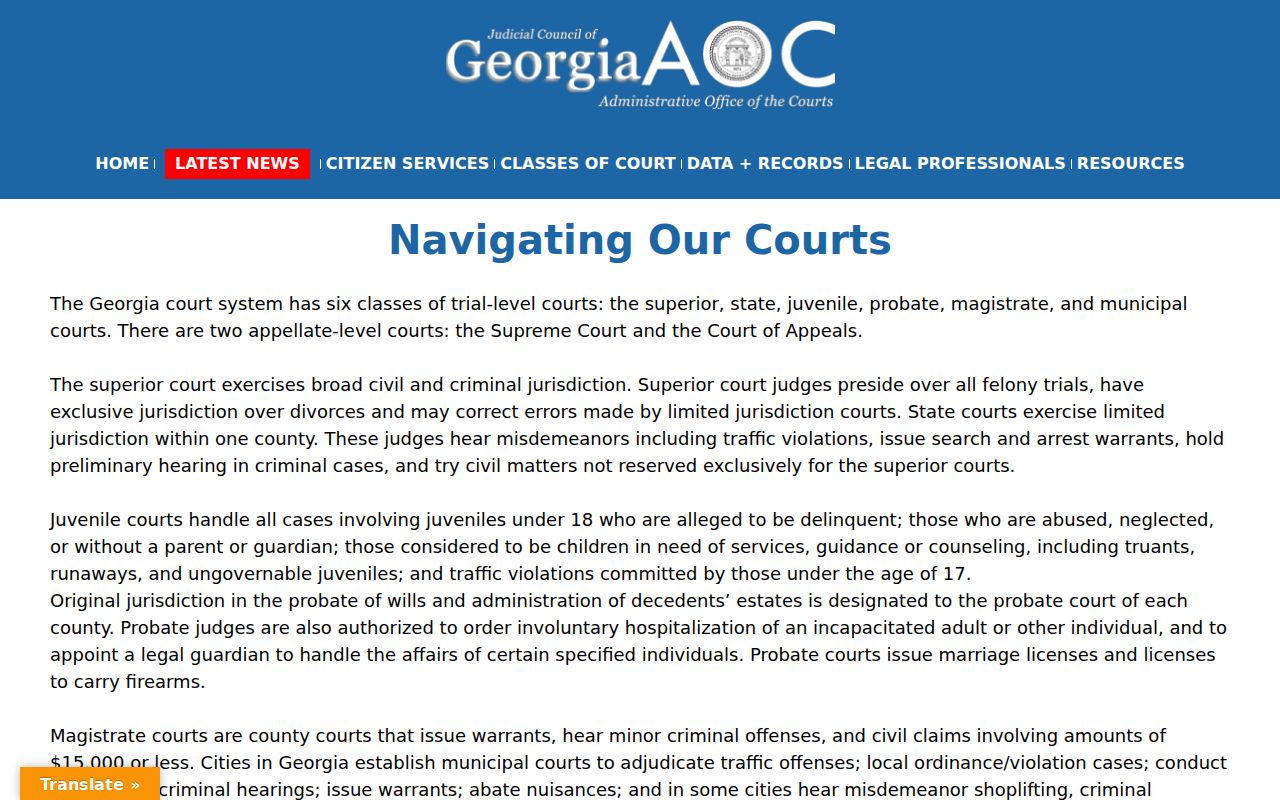
That jurisdiction check prevents a common mistake: searching only Superior Court for a record created by a State, Magistrate, Probate, or Municipal Court.
What Georgia Court Records Show
A Georgia case result normally identifies the court, county, local case number, case style, type, filing date, status, assigned judge, parties, and attorneys. Its event list is the docket, a time-ordered register of filings, hearings, and rulings. Criminal results may add counts, offense dates, disposition, bond, sentence, probation, fines, and restitution. Civil files can show judgment, garnishment, satisfaction, or appeal. Public document images depend on participation, digitization, payment, and security rules.
| Field | What It Shows |
|---|---|
| Case Number | The Georgia court's native identifier; punctuation and format vary by county and vendor. |
| Filing Date | When the Georgia clerk opened the action, not always the event or arrest date. |
| Parties | Georgia plaintiff, petitioner, state, defendant, respondent, and counsel roles. |
| Charges or Claims | Allegations filed with the Georgia court; each count or civil claim must be read separately. |
| Disposition | The Georgia outcome of a case or count, such as dismissal, plea, verdict, transfer, or judgment. |
| Sentence or Judgment | The signed Georgia court result, including relief, confinement, probation, costs, or later amendment. |
Georgia does not impose one public case-number format across all courts. Copy the exact number from the notice or docket and review events after the apparent final order. A later appeal, amended sentence, satisfaction, revocation, or remittitur may change how the result should be understood.
Georgia Court and Agency Records
Several Georgia systems compile records that are not the original county case file. The Department of Corrections locator covers people in state correctional custody, not everyone booked into a county jail. The Georgia Crime Information Center compiles contributed arrests, charges, dispositions, and custody information under different public, personal-inspection, consent, and fingerprint access routes. The Department of Driver Services maintains driving histories after courts report qualifying actions. The State Office of Vital Records has limited historical marriage and divorce coverage, while current original records remain with county Probate or Superior Court clerks.
Each derivative system answers a different question. A GDC profile does not prove every charge in the sentencing case. A GCIC history is not a certified indictment or disposition. A DDS motor vehicle report does not contain the full traffic court file. DPH verification is not a divorce decree. Search the state system for its stated purpose, then return to the originating county clerk when the underlying document or certified judgment is needed.
| System | What It Holds | Run By |
|---|---|---|
| GDC Offender Query | Georgia state offenders, facility, sentence, and status fields when shown | Georgia Department of Corrections |
| GCIC criminal history | Contributed Georgia arrest, charge, disposition, and custody data | Georgia Bureau of Investigation |
| DDS driving history | Georgia license status and 3-year, 7-year, or lifetime driving history products | Georgia Department of Driver Services |
| DPH Vital Records | Georgia vital-record searches, with limited historic marriage and divorce coverage | Georgia Department of Public Health |
| Sex Offender Registry | Georgia public registration profiles subject to registry terms and live verification | Georgia Bureau of Investigation |
Georgia Court Records Access Law
Georgia's Open Records Act declares agency records open unless a statute, court order, or other legal rule protects them. A request goes to the office that keeps the record. Routine clerk inspection and copy procedures are usually the fastest route for a known case. For a formal request, describe the county, court, case or subject, date range, and exact existing documents. Ask for an electronic copy and cost estimate. The custodian generally must respond within three business days, but that deadline can be met with a production schedule and estimate when retrieval or redaction takes longer.
Key Statutes:
O.C.G.A. § 50-18-70 states the open-record principle and directs requests to the actual custodian.
O.C.G.A. § 50-18-71 governs inspection, copies, electronic records, reasonable charges, estimates, and response procedure.
O.C.G.A. § 50-18-72 lists exemptions and requires a legal basis for withholding.
O.C.G.A. §§ 35-3-34 through 35-3-37 govern criminal-history dissemination and Georgia record restriction.
Restricted Georgia Court Records
Public access has firm limits. Juvenile files use statutory, role-based access. Adoption records are sealed. Mental-health, treatment, and competency material may be confidential even when a docket shows that an order occurred. Courts can seal whole cases or particular documents. Public copies should mask protected Social Security numbers, accounts, minor or victim data, and addresses protected by law. Discovery that was exchanged but never filed is not a clerk record.
Georgia calls its main criminal-history remedy record restriction. It limits eligible information in public GCIC dissemination and does not automatically destroy courthouse dockets, jail records, news reports, or every private copy. Court sealing may require a separate order. First Offender treatment also has its own effect and should not be described as an ordinary conviction or automatic deletion. A person seeking correction or restriction should first obtain the GCIC history and certified dispositions from each prosecuting county.
Find Georgia Court Records by County
Georgia trial records are filed locally, even when a Superior Court circuit serves several counties. Use the county where the case, citation, arrest, estate, or marriage license arose. Then choose the correct court and clerk. The six featured counties below represent large metro and regional systems with multiple court classes. Every one of Georgia's 159 county sites provides the local route needed when statewide E-Access is partial, a record is paper-only, or a certified copy must come from the custodian.
Fulton County
Atlanta · Georgia's largest county court system and a single-county Superior Court circuit
Gwinnett County
Lawrenceville · high-volume metro Superior, State, Magistrate, Probate, and Juvenile courts
Cobb County
Marietta · single-county judicial circuit with separate court-class offices
DeKalb County
Decatur · Stone Mountain Judicial Circuit and several county and city venues
Clayton County
Jonesboro · Atlanta-metro records split among Superior, State, Magistrate, and Probate courts
Chatham County
Savannah · Eastern Judicial Circuit and multiple county and municipal record sources
Browse the full directory of all 159 Georgia counties to open the court records site for any county.
Georgia Court Records Fees
Georgia does not have one reliable statewide price for civil filings, divorce, probate work, clerk searches, copies, certification, or provider downloads. State schedules establish some components, while county charges, service, publication, postage, and vendor fees change the total. Ask the filing clerk for a current written fee sheet and say whether inspection, a plain copy, a certified copy, or exemplification is needed. A portal document charge does not buy clerk certification.
| Item | Amount |
|---|---|
| Georgia DDS 3-year driving history | $7 |
| Georgia DDS 7-year or lifetime history | $9 |
| Georgia DPH marriage search with one certified copy if found | $10; simultaneous extra copy $5 |
| Probate marriage certificate | $10, subject to current county schedule |
| Court search, copy, certification, portal, or postage | Current custodian and provider schedule |
Reading Georgia Court Records
Read each count and the signed disposition. An arrest or charge is an allegation, not a conviction. Nolle prosequi means the prosecutor stopped that charge at that time. A dead docket is inactive, not an acquittal. A no bill is grand-jury action. First Offender language must be followed through later discharge or revocation entries. In a multi-count case, one count may be dismissed while another ends in a plea or verdict. Georgia vendors also abbreviate events differently, so use that court's legend or signed document rather than imposing a statewide code.
- Case style
- The caption naming the parties, such as State of Georgia versus a defendant.
- Docket
- The chronological register of filings, hearings, and rulings.
- Disposition
- The outcome of a whole case or an individual count.
- Remittitur
- The appellate court's formal return of its decision to the lower court.
Georgia Court Record Accuracy
Georgia record systems update on different schedules. An arrest booking can appear before a prosecutor files charges. An e-filed document may not appear until clerk acceptance. GCIC depends on contributor submissions, GDC follows commitment and intake, DDS waits for court reporting, and VINELink follows participating agency feeds. Older records may be paper, microfilm, offsite, or subject to an approved retention schedule. Search spelling variants, the incident county, the right court class, and the complete date range before concluding that a record does not exist.
Note: Confirm identity, current status, and any formal conclusion with the Georgia clerk or agency that maintains the source record.
Georgia Court Records History
Georgia authorized a Supreme Court in 1835 but did not establish it until 1845. Its first session began in Talbotton in 1846, and the original judges traveled among court sites before the 1865 Constitution placed the Court at the seat of government. The Court of Appeals followed in 1906 to relieve appellate workload. Modern reforms expanded the Supreme Court to nine justices and the Court of Appeals to 15 judges in five divisions, while trial records continued to be kept in their filing counties.
The Supreme Court of Georgia's official history records the high court's development, jurisdiction, and institutional changes.
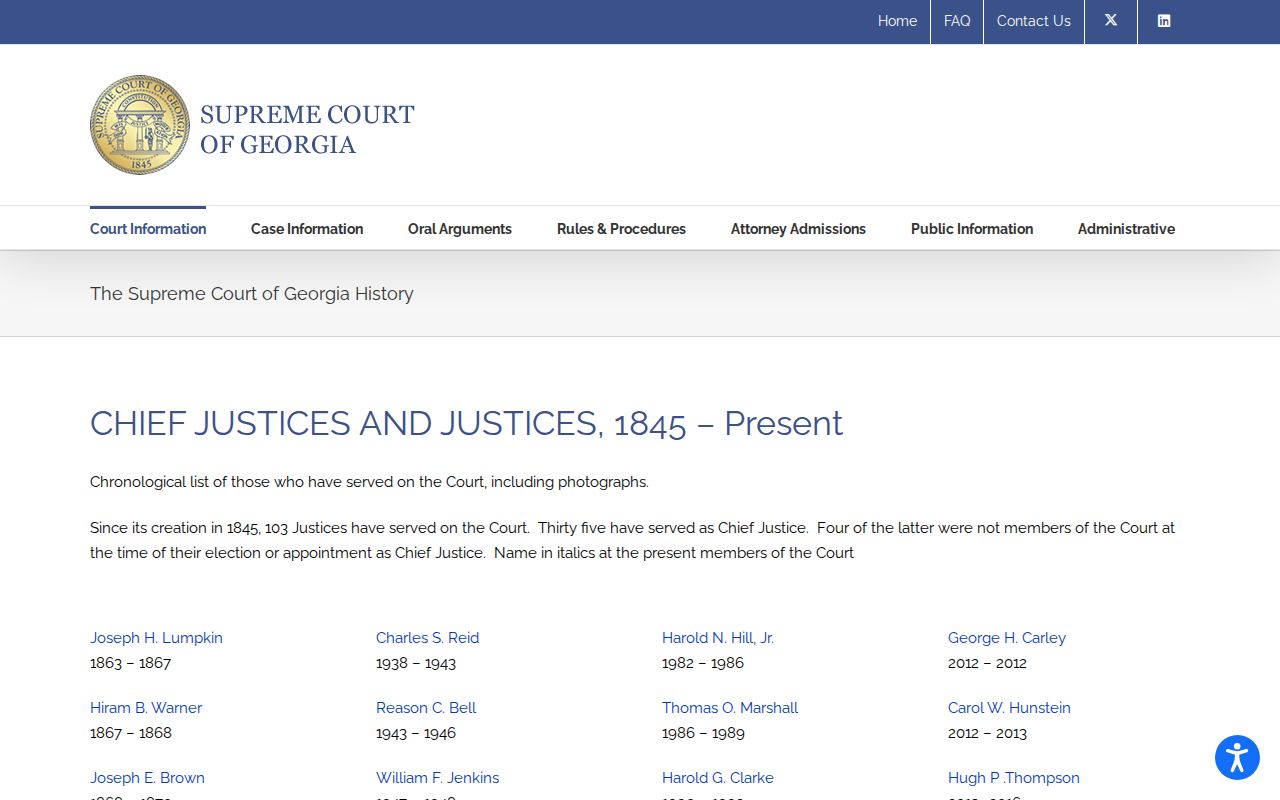
The Court's history explains why Georgia now has a centralized appellate structure but a county-based network for most trial case files.
The Court of Appeals of Georgia separately publishes its opinions, calendars, rules, and clerk resources.
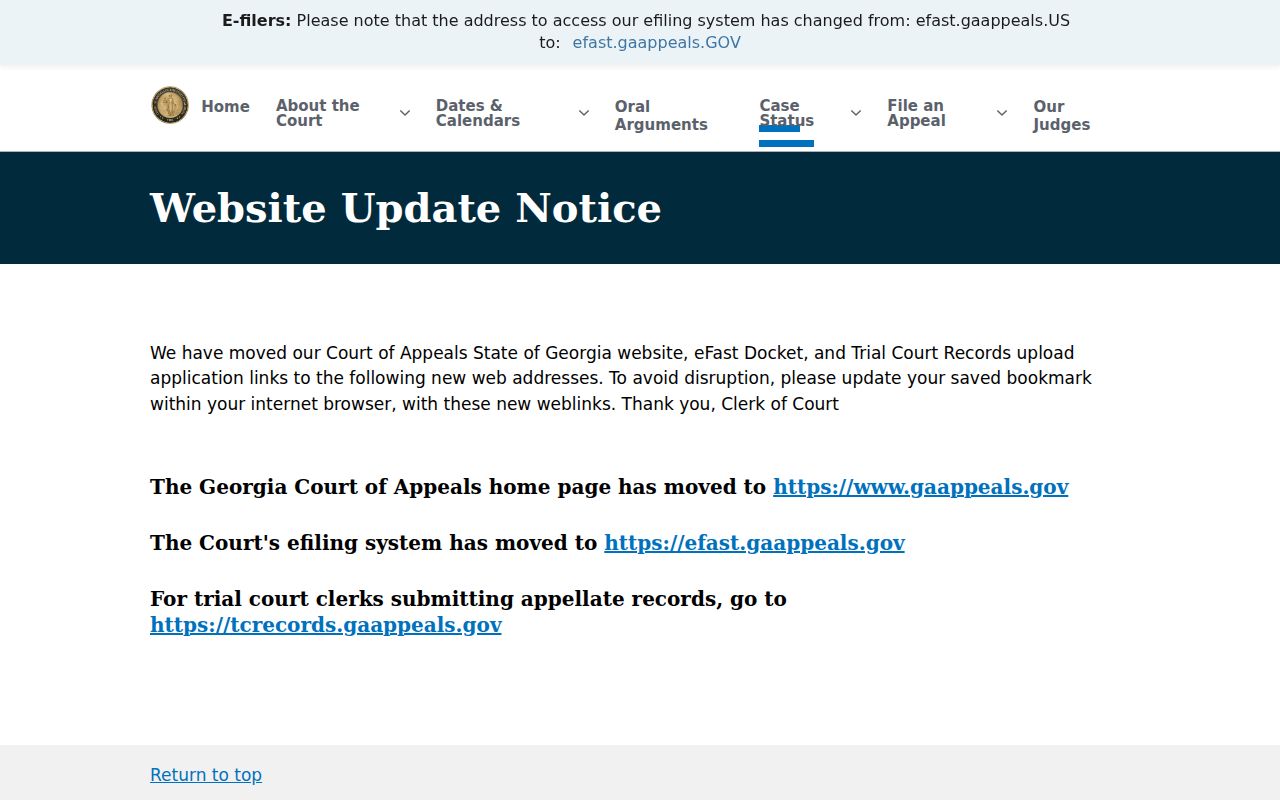
Those appellate resources cover cases on review and should not be treated as a complete index of the underlying Superior, State, or local court record.
Georgia Court Records Reforms
Georgia's 2025 and 2026 court changes include probate e-filing authority, digital-takedown legislation, and stronger protection for judges' identifying information. These are dated developments, not proof that every Probate Court now offers public e-access or that any unfavorable docket can be erased. Implementation depends on the enacted law, court rules, provider rollout, and local participation. Security measures also explain some intentional redactions in otherwise public records.
The Judicial Council publishes annual summaries of judiciary-related enacted legislation for checking each measure's stated effect.
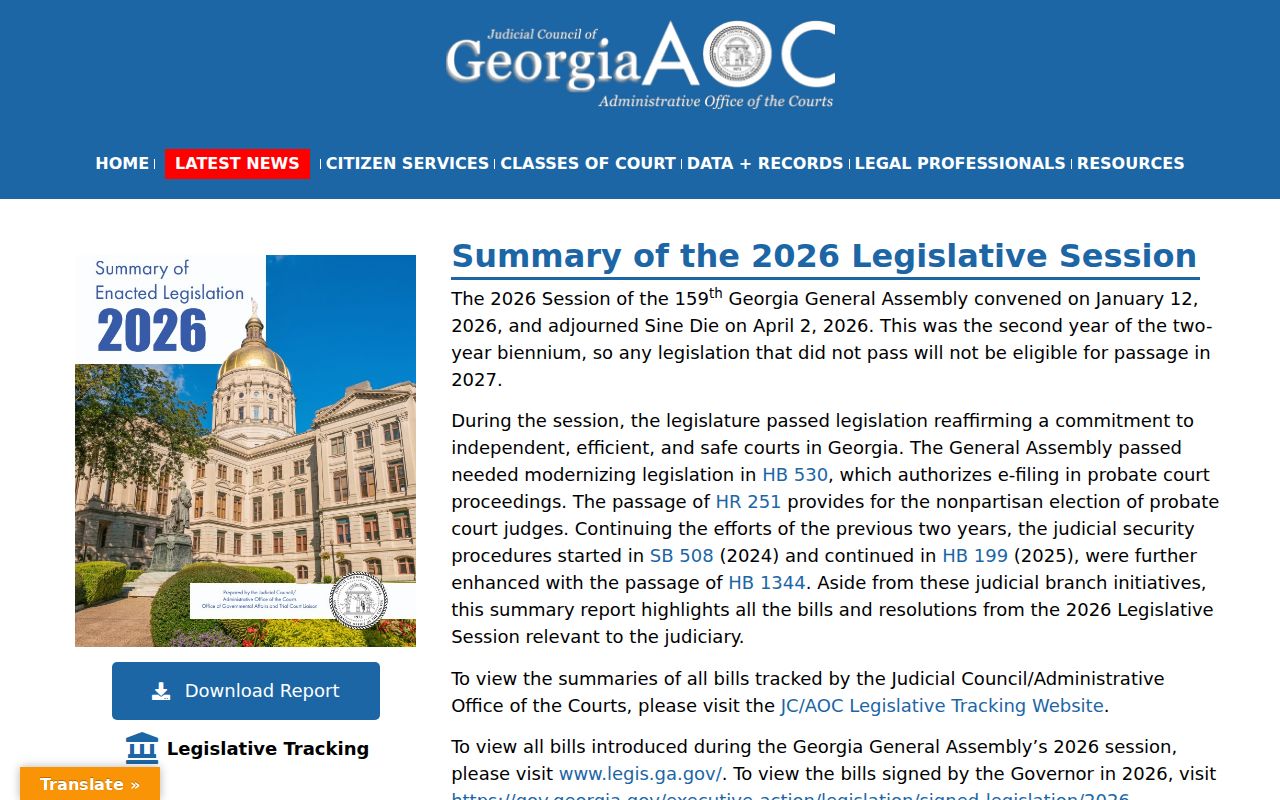
Current legislation summaries should be read with effective dates and any implementing rules before a new access method is described as statewide.
Dated statewide notices and administrative changes also appear in the official Georgia Courts press releases.
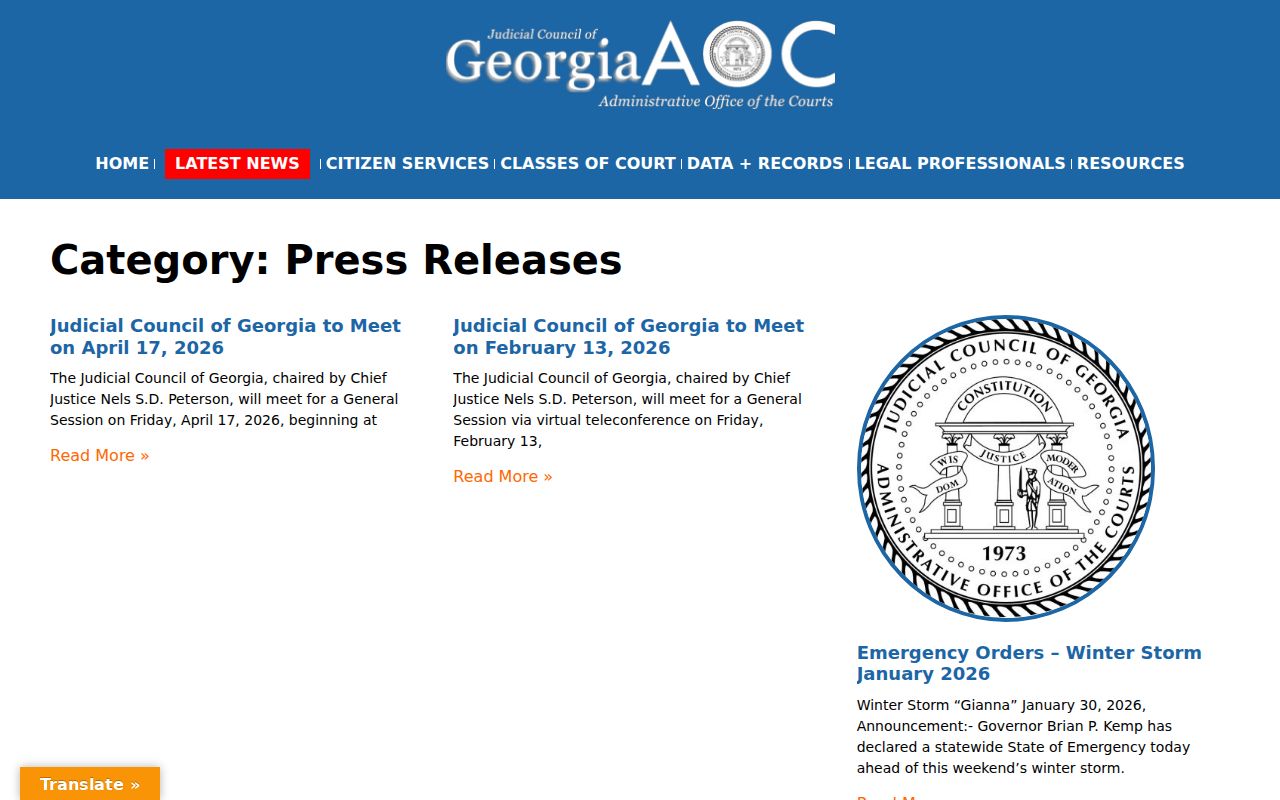
Press releases are useful for recent context, while the clerk and live court matrix remain the authority for present search coverage.
Georgia Court Records Questions
Is there one free Georgia court records search? No. Georgia Courts provides E-Access routing for participating Superior and State Courts, and an account is required. Other courts and older files may require a local portal, clerk terminal, mail request, or archive search.
Which clerk has a Georgia felony or divorce file? The Clerk of Superior Court in the filing county normally holds both because Superior Court has exclusive felony and divorce jurisdiction. A multi-county circuit does not move the file away from its venue county.
Does an empty online search prove there is no case? No. Check the name, alias, date range, county, court class, provider coverage, recent indexing delay, archive status, and access restriction. Ask the clerk about a formal no-record search if one is required.
Are Georgia juvenile and adoption records public? Access is restricted. Juvenile files use role-based statutory rules, while adoption files are sealed. Contact the proper court about identity proof, authorized access, or a court-order process.
How is a certified Georgia court record obtained? Request it from the clerk that maintains the original case. State the case number, document, copy type, delivery method, and maximum cost. Provider downloads and docket screenshots are not certified copies.
Where are Georgia federal records searched? Federal cases use PACER and the Northern, Middle, or Southern District of Georgia, with appeals in the Eleventh Circuit. Federal records do not appear in Georgia trial-court providers.