
Georgia Criminal Case Files
A Georgia criminal court record begins when a charging paper is filed with a Georgia trial court. The Georgia clerk preserves the indictment or accusation, count-level allegations, service and bond entries, motions, hearing notices, plea or verdict, sentence, and later appeal activity. The Georgia case file is more complete than an arrest entry because it shows what prosecutors pursued and what the judge ordered. A Georgia court file is also more exact than a compiled history when a certified disposition is needed. Booking facts and initial allegations belong to Georgia arrest and court charge records, while later Georgia custody placement belongs to a separate system.
Georgia felonies proceed in Superior Court, the general-jurisdiction trial court present in every Georgia county. Georgia misdemeanors commonly proceed in State Court, where one exists, or in an authorized Municipal or other local court. Georgia does not have State Court in every county, so the Georgia court name cannot be assumed from the charge alone. The Georgia Clerk of Superior Court keeps a Superior Court prosecution. A Georgia State, Magistrate, or Municipal Court maintains its own files through its clerk or records office. Use the Georgia court printed on a notice, bond paper, or citation.
Search Georgia Criminal Records
The Georgia Courts E-Access list routes users to providers serving listed Georgia Superior and State Courts. Georgia coverage is court-specific, not universal. A Georgia provider account may be required, and a participating Superior Court does not mean every other Georgia court in that county is online. Provider search or image fees may apply. When a Georgia record is absent, use the Georgia county directory to identify the exact Georgia clerk. Counter inspection, mail, clerk-approved email or fax, and a focused written request remain valid Georgia access channels for files that are older, archived, or not digitized.
- Identify the prosecution county and court from a notice, citation, bond paper, or known case number.
- Check the official E-Access participation list, then follow the listed provider or local clerk link.
- Search the exact case number first. For a name search, try the legal name, prior names, and date range.
- Open each count and read later docket entries, the signed disposition, sentence, and any amended order.
- Order an ordinary or certified copy from the clerk when a portal display is not enough.
Georgia case numbers vary by county and vendor. Preserve Georgia prefixes, leading zeroes, spaces, and hyphens exactly as printed. A Georgia “no results” screen may reflect a spelling issue, wrong court, account limit, or paper-only file. It does not prove no Georgia criminal case exists. Ask whether the Georgia file uses another name, sits in archives, or has a public docket shell with images withheld.
Note: A Georgia portal result is an index entry, not a clerk-certified copy of the filed criminal case document.
Georgia Criminal Case Stages
A Georgia arrest may lead to a first appearance, bond review, and preliminary hearing before a filed Georgia trial case develops. A Georgia district attorney prosecutes Superior Court felonies. A Georgia solicitor-general prosecutes State Court misdemeanors. Georgia felony counts normally reach Superior Court through a grand-jury indictment unless waived or another method is authorized. A Georgia accusation is the prosecutor-filed instrument commonly used for misdemeanors and eligible felonies. Each Georgia stage leaves a different docket trace, and the charge can change before final judgment.
Case flow: Charges Filed › Arraignment › Pretrial / Motions › Plea or Trial › Disposition › Sentencing
At a Georgia arraignment, the filed charges are addressed and the defendant enters a plea. Georgia pretrial entries can record discovery disputes, suppression motions, bond issues, and continuances. A Georgia plea or trial then resolves each count, while the signed Georgia sentencing order sets out confinement, probation, fines, restitution, conditions, and the relationship among terms.
What Georgia Criminal Records Show
Georgia court portals differ, but the Georgia clerk file usually links identity, charge, docket, and outcome data. Georgia public images may include motions, notices, returns, orders, accusations, indictments, sentences, and appeal notices. Georgia transcripts often require a separate order and charge. Georgia exhibits may remain physical, may have been returned, or may be sealed. A Georgia portal display is current information subject to indexing lag; an ordinary Georgia copy reproduces a filing; a certified Georgia copy adds the clerk’s authentication.
| Field | What It Shows |
|---|---|
| Case number | The local identifier, including any year or case-type prefix. |
| Defendant | The accused person, counsel, and party role, with protected identifiers masked. |
| Charges | Each count, offense text, statute, severity, offense date, and amendment. |
| Plea | The response to each count, including guilty, not guilty, or nolo contendere where accepted. |
| Disposition | The count-level outcome and date, such as guilty, acquitted, dismissed, no bill, or nolle prosequi. |
| Sentence | Confinement and probation split, fines, restitution, conditions, and concurrent or consecutive terms. |
Georgia Charges Versus Convictions
A Georgia charge is an allegation. A Georgia conviction is a judgment of guilt based on a plea or verdict. One Georgia case may contain several counts with different outcomes, so a Georgia “disposed” label cannot be read as a conviction on every charge. One Georgia count may show nolle prosequi while another shows a guilty plea. A Georgia indictment shows probable cause found by a grand jury, not proof beyond a reasonable doubt.
| Question | Charge | Conviction |
|---|---|---|
| Meaning | Formal allegation in an authorized charging instrument | Judgment of guilt after an accepted plea or guilty verdict |
| How to verify | Read the latest count and charging paper | Read the signed final disposition and sentence |
| Possible change | May be amended, reduced, dismissed, no billed, or dead docketed | May be affected by First Offender treatment, appeal, vacatur, or correction |
Read Georgia Case Outcomes
Read every Georgia count, then open the signed Georgia sentence and all later entries. Georgia “nolle prosequi” means the prosecutor formally chose not to continue that charge at that time. A Georgia “no bill” records grand-jury action, not a trial acquittal. A Georgia dead-docket entry makes a count inactive by court order and is not dismissal. Georgia First Offender language at sentencing is not an ordinary conviction label; successful discharge and exoneration must be verified through later Georgia records. A Georgia nolo contendere plea has consequences set by law and should not be paraphrased as “not guilty.”
A Georgia sentence may split a term between confinement and probation. A Georgia order may make separate count terms concurrent or consecutive. Check Georgia fines, costs, restitution, and conditions, then scan for revocation, amended sentence, appeal, remittitur, or vacatur. The latest Georgia docket entry is not always the controlling order. Certification from the Georgia clerk is the sound source when the result will be presented to a court, licensing body, employer, or another institution.
Note: Read later amended orders and appeal entries before treating the first Georgia sentence shown as the final controlling result.
Georgia Sealed Versus Expunged Records
Georgia calls its principal criminal-history remedy record restriction, not literal expungement. Under O.C.G.A. § 35-3-37 and GBI procedure, eligible arrests can include matters not referred for prosecution, dismissals, acquittals, certain time-expired prosecutor decisions, and identity-theft cases. Eligibility depends on the disposition. A conviction does not vanish merely because time passed. For older or unresolved matters, the applicant, arresting agency, prosecutor, and GCIC each have a role in the restriction process.
| Point | Sealed Court Record | “Expunged” or Restricted History |
|---|---|---|
| Effect | Limits access to the covered case or document | Limits public GCIC dissemination but does not erase every other copy |
| Process | May require a motion and court order | May involve the arresting agency, prosecutor, and GCIC |
| Other records | Depends on the scope of the order | Courthouse dockets, jail logs, news, or private copies may remain |
Georgia Criminal Record Access
Public Superior Court criminal filings ordinarily include indictments or accusations, motions, pleas or verdicts, and sentences unless a law or order restricts them. Use the normal clerk search and copy process first. For an identifiable agency record, Georgia’s Open Records Act calls for a request to the actual custodian. A useful request names the court, county, defendant, case number or date span, exact documents, desired format, and whether certification is needed. Ask for an estimate before a stated cost limit.
Key statutes:
O.C.G.A. § 50-18-70 declares agency records open unless law or court order provides otherwise.
O.C.G.A. §§ 50-18-71 and 50-18-72 address procedure, reasonable charges, electronic records, and exemptions.
Georgia Statewide Criminal History
The Georgia Crime Information Center within the Georgia Bureau of Investigation maintains computerized criminal history. It can contain identity data, reported arrests and charges, final judicial dispositions submitted by source agencies, and Georgia correctional custody information. It is an event repository, not the pleadings, motions, or full docket from one prosecution. A person can seek a Georgia history through participating sheriff or police agencies. Authorized employment and licensing checks use GAPS fingerprint services under the applicable service code and consent rules.
Public felony-conviction access permitted by O.C.G.A. § 35-3-34(d.2) uses full name, race, sex, and date of birth through Georgia Felon Search, with the current transaction amount shown before payment. A missing GCIC disposition should be corrected at its source: obtain the certified court disposition, then ask the submitting court, prosecutor, or arresting agency to transmit the update. GCIC cannot create source data that was never sent.
The official GCIC criminal-history guidance explains access, correction, and restriction. Its public guidance is shown in the source capture below.
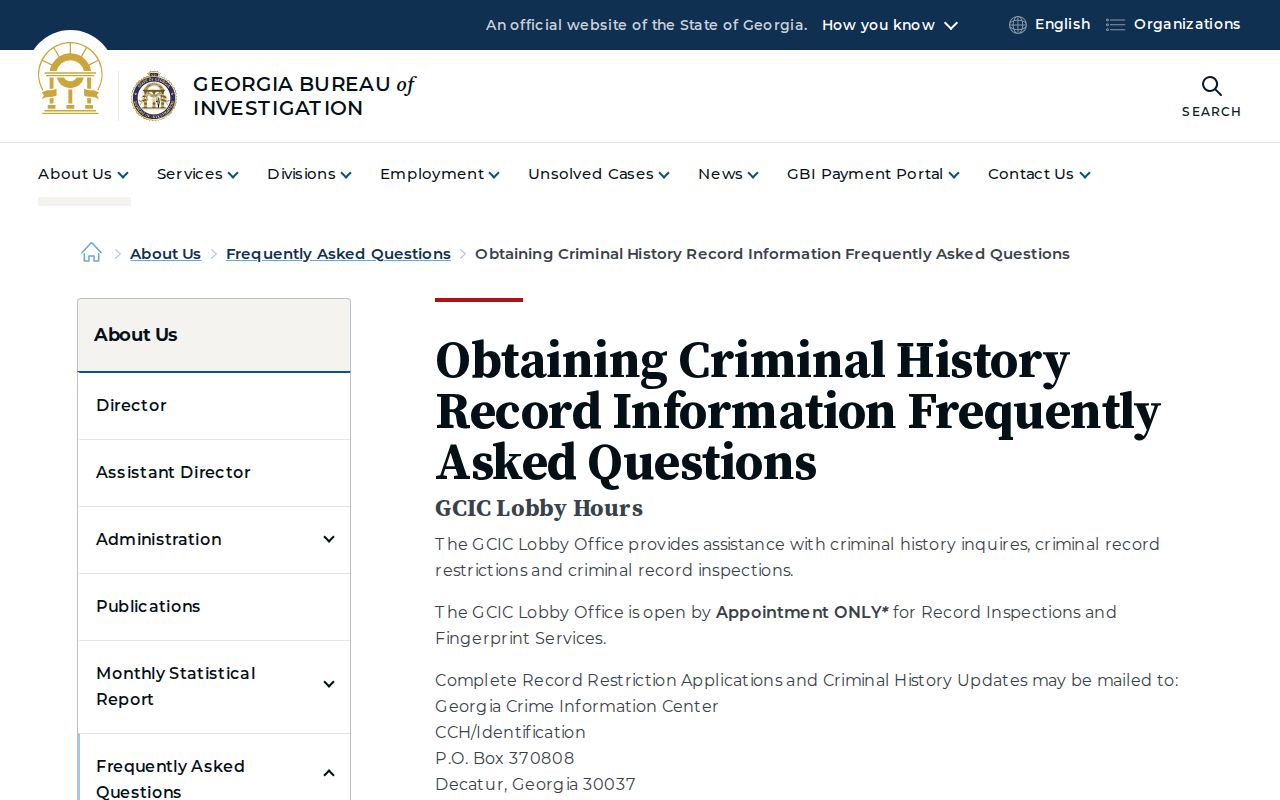
The agency guidance belongs beside the clerk’s certified case record, especially when names match more than one person or a disposition is incomplete.
The authorized GAPS and IdentoGO registration system handles fingerprint-based Georgia and FBI checks for approved purposes.

GAPS requires the correct service code or agency account, photo identification, and the applicable fingerprinting payment.
The Georgia Sex Offender Registry is another statewide GBI system, but it is not a full criminal-court history.
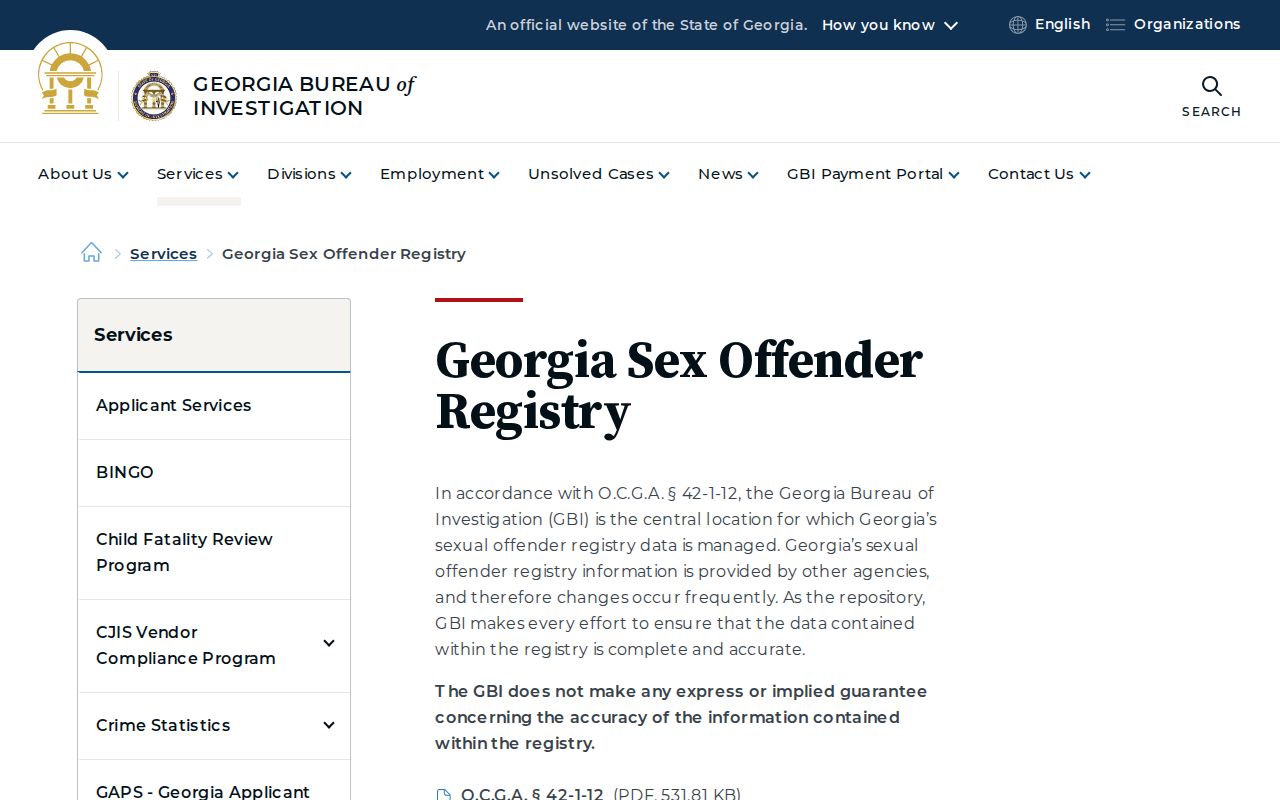
Registry profiles must be read with the official terms and verified against the live record and local sheriff when current status matters.
Note: GCIC history and a Georgia county criminal file answer different questions, so neither record should silently replace the other.
Restricted Georgia Criminal Records
Juvenile access is role-based under Georgia law; an open-hearing exception does not make the full file public. Adoption matters, mental-health evaluations, sealed documents, grand-jury deliberations, protected discovery, informant details, and active investigative material can also be unavailable. Clerks mask Social Security and account numbers, protected birth or address data, victim and minor identifiers, and medical information where required. Discovery held by the parties but never filed is not a clerk record.
If a record seems missing, confirm the court, county, spelling, and date range before assuming it is sealed. Ask whether it is paper-only, indexed under an alias, or represented by a docket shell with images suppressed. A custodian should identify the legal basis for withholding, but an Open Records Act request cannot override a sealing order or force creation of a new report. The county directory routes requests to the office holding the Georgia criminal case.
Note: Record restriction, court sealing, First Offender treatment, pardon, and informal “expungement” language describe different legal effects in Georgia.