
What Georgia Probate Court Covers
Every Georgia county has a dedicated Probate Court and an elected probate judge. Its core work includes admitting wills, appointing executors or administrators, supervising estate administration, deciding year's-support petitions, and handling guardianships and conservatorships. Probate Courts also issue marriage licenses and weapons-carry licenses. Some probate judges perform election, vital-record, or traffic functions under local authority, but those duties do not turn every Probate Court record into a public estate document.
Georgia estate venue follows the decedent's domicile and other legally relevant property facts, not where an heir now lives. The Georgia county file remains local. A Georgia judge may serve a well-known public system, yet there is no central Atlanta archive that replaces the Georgia county record. Use the Georgia county directory to find the court that owns the original file. For a Georgia estate, ask separately for the will, petition, letters, inventory or returns if public, creditor claims, orders, and discharge because a Georgia index result may show only the case shell.
Georgia also uses fact-specific alternatives. “No administration necessary” may apply when debts are paid and heirs agree on distribution, but Georgia does not have a universal small-estate affidavit that transfers all assets below one simple dollar limit. Asset type and current law matter.
A filed Georgia will and an administered Georgia estate are not the same thing. The Georgia court must act on the petition and issue letters before a representative has court-backed authority. Georgia probate in solemn form and common form carry different notice and finality effects. If a Georgia dispute develops over validity, heirs, property, or fiduciary conduct, the docket can expand through citations, objections, hearings, and appeals. The most useful Georgia record request therefore follows the case past the first petition.
Georgia Probate Terms Defined
Georgia probate dockets use terms that identify the person's role and the court's authority. A will by itself does not authorize someone to act. The Probate Court admits the will, makes an appointment, and issues letters that show the representative's authority.
- Testator
- The person who made the will later offered to Georgia Probate Court.
- Executor or personal representative
- The person nominated or appointed to administer the Georgia estate.
- Intestate
- Dying without a valid will, so Georgia intestacy rules govern succession.
- Letters testamentary or administration
- The Georgia court-issued proof that authorizes the appointed representative to act.
- Guardianship
- Authority over personal decisions for a minor or legally incapacitated adult.
- Conservatorship
- Authority over property and finances for a protected person.
- Inventory and returns
- Reports about estate property and administration, when not waived or restricted.
Search Georgia Probate Records
There is no comprehensive free statewide public Georgia probate case search. The Georgia Probate Court Information System, or PCIS, supports court administration for licenses, wills, guardianships, estates, fees, and agency integrations. Its Georgia statewide infrastructure does not mean the public can search every county by name through one portal. Use a Georgia county's official index when offered, then call, visit, or mail its Georgia Probate Court clerk for files outside the online span.
The Judicial Council describes the Probate Court Information System and its operational role.
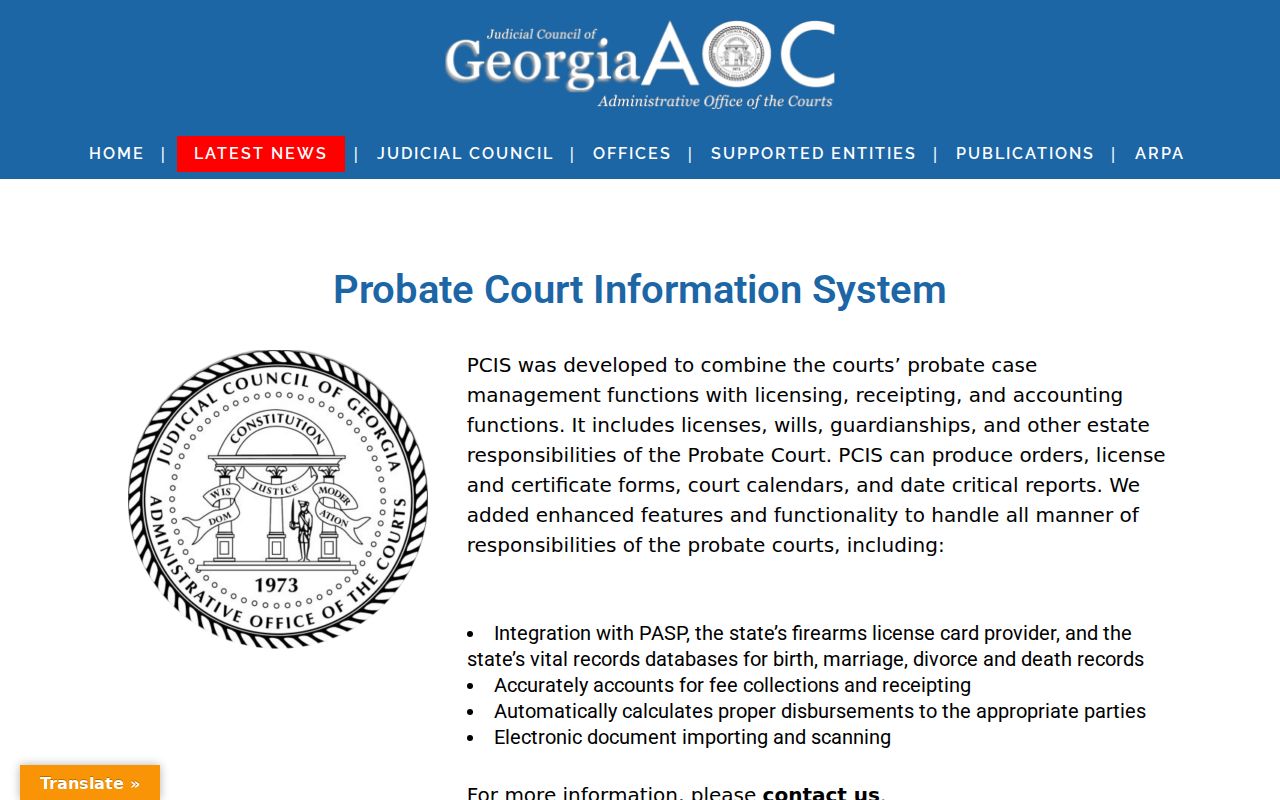
The official PCIS screen confirms system functions, while public record access still routes to the individual Georgia Probate Court. Search by the decedent or ward's last and first name, estate or case number, filing year, date range, case type, and status. Older files may be in a paper archive or on microfilm.
- Identify the Georgia domicile or venue county and the approximate death or filing date.
- Open that Georgia county's Probate Court site through the county directory.
- Search the Georgia local index by full name, aliases, case number, year, and case type where available.
- Ask the Georgia clerk to check paper, microfilm, or offsite indexes when the portal is incomplete.
- Request the exact Georgia documents and state whether plain, certified, or exemplified copies are required.
Note: No online result can prove that a Georgia decedent left no will or estate, because venue, spelling, archive, and filing choices can differ.
Georgia Probate Court Locations
Each of Georgia's 159 counties has a Probate Court, but addresses, counter hours, online coverage, payment methods, and archive practices are local. Select the county tied to the decedent or proceeding. A nearby Probate Court cannot certify another county's file. If real property changed hands through an executor or administrator, a separate deed record may also exist with the Clerk of Superior Court and the statewide clerks' authority systems.
Find the custodian: Browse the directory of all 159 Georgia counties, then choose the county Probate Court rather than a generic courthouse office.
Georgia Probate Record Fees
Georgia estate filing totals vary by petition, pages, citations, service, publication, copies, and county additions. Georgia research supports specific statewide schedule items, but not one responsible all-in estate price. Request a written quote from the Georgia filing court. Separate the Georgia petition fee from sheriff service, publication, certified copies, exemplification, postage, and any online charge. A Georgia poverty affidavit may request relief, but a judge determines qualification and not every expense is necessarily waived.
| Item | Amount |
|---|---|
| Estate petition and related process | Current county quote by petition and service needs |
| Creditor claim | $15 statewide schedule item |
| Exemplification | $15 plus copies or pages |
| Marriage certificate | $10 statewide probate schedule item |
| Plain or certified estate copies | County schedule, pages, certification, and delivery |
What Georgia Probate Records Show
A public Georgia estate file may identify the case number, decedent, open date, petition type, petitioner, personal representative, counsel, judge, docket events, admitted will, oath, bond, letters, citations, publication, creditor claims, sale or distribution orders, and discharge. Inventory and annual returns can appear when required and public. A docket event alone may not answer the question. “Will filed” does not prove admission, “letters” can later be revoked, and an open case does not show that each claim was allowed.
Georgia recognizes probate in common and solemn form, which differ in notice and finality. Administration applies when there is no valid will or the nominated executor cannot serve. A year's-support petition is a distinct Georgia remedy for an eligible spouse or minor child and can affect estate and property records. The representative gathers property, gives required notice, handles valid debts and expenses, distributes under the will or intestacy, and seeks discharge when complete.
Georgia probate timelines range from months to years. Georgia creditor periods, taxes, real estate, disputed heirship, caveats, bond, and litigation prevent a single guaranteed finish date. Read later Georgia events for amended letters, objections, appeal, settlement, or discharge rather than relying on the first order.
Georgia property research may require a second record system. An executor's or administrator's deed is recorded through the Georgia Superior Court clerk's land-record function, while the authority to make the transfer comes from the Georgia probate file. Compare the names, legal description, letters, sale order when required, deed, and final accounting. One Georgia source shows court authority; the other shows the recorded land transaction.
Restricted Georgia Probate Records
Many admitted wills, estate petitions, letters, and estate orders are traditionally public, but access is not uniform across every item. A will deposited for safekeeping before the testator's death is unavailable to an ordinary public search. Guardianship evaluations, health records, financial reports, information about minors, weapons-license data, and adoption-connected material can be restricted. A visible docket shell does not guarantee public document images.
Guardianship concerns personal decisions; conservatorship concerns property and finances. These cases can include evaluations, investigation, appointed counsel or guardian ad litem work, hearings, and ongoing reports. Ask the clerk what proof of authority, party status, redacted-copy process, motion, or court order applies. The Open Records Act does not override another law or judicial order that bars release.
Privacy also matters in an otherwise public estate. Do not republish account numbers, medical details, protected addresses, full birth dates, or a minor's identifiers. A certified copy should come from the clerk, not from a portal screenshot.
Find Any Georgia Probate Court
Start with the decedent's domicile at death, then account for any different property venue or transferred proceeding. The full Georgia county directory reaches local court information for all 159 counties. Give the clerk the full name and aliases, death date, approximate filing period, and any known petitioner or representative. Ask whether the file is online, at the counter, on microfilm, or in an offsite archive.
For a useful certified request, name each item: will, petition, order admitting the will, letters, inventory or returns if public, creditor claim, sale order, year's-support order, and discharge. State the certification level, delivery format, mailing address, and maximum cost. That scope is faster and more accurate than asking for “all probate records” without a county or date.